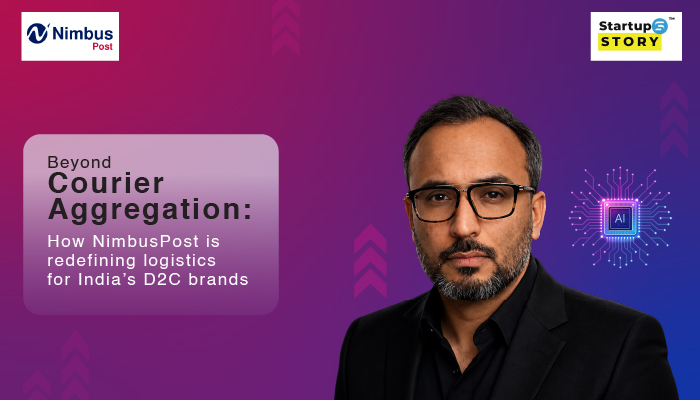
Beyond Courier Aggregation: How NimbusPost Is Redefining Logistics for India’s D2C Brands
- ByStartupStory | July 15, 2026
For every D2C founder in India, the real concern isn’t the sale, it’s what happens after. An order leaves the warehouse and quietly turns into a question mark, a courier that doesn’t arrive on time, a customer left without an explanation, a return that lands back with no context attached. Scaled across a few thousand orders a month, what looks like a shipping problem becomes something costlier a trust problem, steadily eroding every rupee spent acquiring that customer.
This is the gap NimbusPost has spent six years trying to close not just moving parcels but making the decision behind every parcel smarter.
“In the early days, brands were fetching orders from multiple storefronts and uploading them individually across courier platforms. Every carrier had a different SOP, a different escalation matrix,” says Ankit Sood, CEO of NimbusPost. “But underneath that operational chaos was a deeper problem, a data black hole.”
That black hole shipments generating signals nobody could read is the starting point for understanding what NimbusPost is solving today.
Three Eras of a Changing Problem
According to him, D2C in India hasn’t faced one static logistics challenge it’s faced three, evolving in step with the ecosystem itself.
Between 2014 and 2019, the problem was access. Most logistics networks were built for high-volume shippers, leaving smaller and emerging brands underserved. NimbusPost’s earliest mandate was simple: democratize courier access so that businesses of any size could ship reliably across India.
By 2019, access was no longer the bottleneck visibility was. Brands were scaling fast, but RTOs were climbing, with many getting generated before sellers had assessed whether the order intent was genuine. “Operational intelligence became the new challenge,” he explains. NimbusPost’s response was to evolve from a courier aggregator into an intelligence-led platform, one that could help brands see their own logistics performance clearly enough to act on it.
Today, in what he calls the D2C 3.0 era, the question has shifted again from “did the order deliver” to “did the business make money, and will this customer come back.” Retention, profitability, and unit economics are now logistics problems as much as they’re growth problems.
From Reactive to Predictive Logistics
Rather than simply reporting what has already gone wrong, NimbusPost is focused on preventing delivery failures before they occur. Through pre-dispatch checks such as address verification, COD confirmation, and duplicate-order detection, the platform helps brands minimise avoidable risks before shipments leave the warehouse.
According to the company, these interventions have helped reduce RTOs by an average of 25–30%, particularly across high-COD and Tier II/III markets. Building on this, NimbusPost is now developing predictive scoring capabilities that can assess an order’s likelihood of successful delivery even before dispatch.
Rethinking RTO: Beyond an Operational Cost
RTO has long been treated as an operational metric something to reduce through better logistics and lower shipping costs. However, Ankit Sood believes this perspective overlooks its far greater business impact. “A customer who orders from a brand for the first time and gets a poor post-purchase experience a missed delivery, no communication, or a package that returns with no explanation is very unlikely to order again,” he says. “The CAC was spent. The relationship was not built.”
For today’s D2C brands, where sustainable growth is increasingly driven by repeat purchases and customer lifetime value rather than one-time acquisitions, a failed first delivery represents far more than a logistical setback. It erodes customer trust before it can be established, weakens retention, and diminishes the return on every acquisition investment.
Seen through this lens, RTO is no longer simply an operational metric to optimise, it becomes a strategic business challenge that must be addressed proactively, by verifying COD before dispatch, recommending couriers on pin-code data, and acting on NDR in real time
Building for India’s Next Growth Markets
For NimbusPost, the shift toward Tier II and Tier III India is no longer an emerging trend it’s where the next phase of e-commerce growth is already unfolding. Bain & Company’s How India Shops Online 2025 reports that nearly 60% of India’s online buyers now come from Tier III towns and smaller, while Inc42’s D2C 3.0 Report 2025 notes that these markets account for 46% of festive e-commerce sales, underscoring their growing influence on the country’s digital commerce landscape.
By combining pin-code-level intelligence with AI-driven courier allocation, with humans in the loop when ground realities intervene, NimbusPost aims to help brands deliver consistently across markets where growth is accelerating the fastest.
The Intelligence Layer Advantage
NimbusPost works with leading logistics partners, including XpressBees, Delhivery, Blue Dart, and DTDC, but Sood believes access to multiple carriers is no longer enough. “The intelligence layer is what NimbusPost owns and delivers to the brand,” he says. Rather than simply offering courier choices, the platform recommends the most suitable carrier for every shipment using pin-code-level performance data.
That intelligence, he explains, makes all the difference. Take a brand shipping to Andhra Pradesh. Pin-code-level data might show Blue Dart outperforming Delhivery by 18 basis points on COD success in that region, and that single data point changes which courier gets the next allocation. By identifying which courier performs best for a specific region and shipment type, NimbusPost helps brands replace guesswork with data-driven logistics decisions.
What Comes Next
NimbusPost is preparing to launch a next-generation version of its platform this quarter, building on six years of standardized logistics infrastructure. Looking ahead, Sood sees Indian logistics being shaped by faster delivery expectations and agentic AI systems that don’t just assist but actively handle tasks such as NDR follow-ups, courier allocation, and demand forecasting.
Six years ago, the challenge was getting a parcel picked up. Today, it’s ensuring that parcel never becomes a problem in the first place. As logistics shifts from moving shipments to anticipating them, NimbusPost believes intelligence will define the next generation of supply chain innovation.

Follow Startup Story


Related Posts