
Jobs Can’t Wait: Why Employment Must Come Before the 8th Pay Commission
- ByStartupStory | July 15, 2026
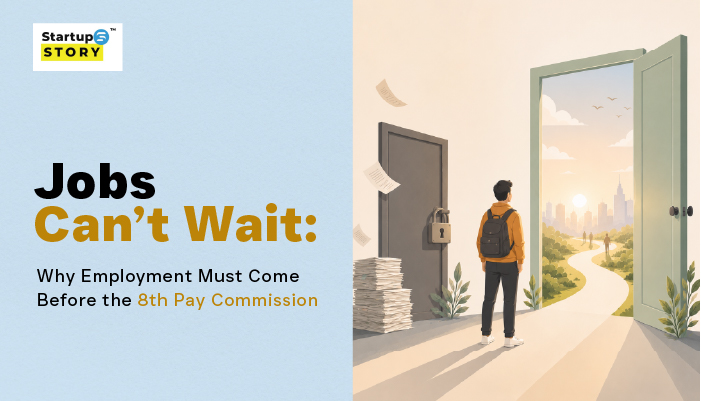
For an ordinary Indian family, the economy is not about GDP numbers, fiscal deficits or stock market charts. The questions are much simpler: Does my child have a job? Is my salary secure? Can I pay my EMI next month?
Today, these questions worry millions of Indians. Graduates spend years searching for stable employment. Private-sector workers face layoffs, automation and AI-driven restructuring. At the same time, India is debating a major salary revision for existing government employees through the 8th Pay Commission.
Government employees deserve fair salaries and protection from inflation. But as citizens, we must ask: Is a large salary revision India’s most urgent priority today?
Perhaps the 8th Pay Commission should be delayed, not cancelled, while employment is treated as a national emergency.
According to the comprehensive government vacancy data cited in the underlying policy analysis, 9,79,327 sanctioned Union Government posts were vacant. Indian Railways alone had around 2.74 lakh Group C vacancies, while nearly 1.87 lakh civilian posts in the Ministry of Defence and about 60,000 positions in India Post were vacant. Thousands of vacancies also existed in tax administration, health services, security forces and investigative agencies.
These are not just empty chairs. An understaffed hospital means longer waits for patients. Vacancies in courts slow justice. Shortages in railways increase pressure on existing workers. An understaffed tax or investigation agency weakens governance.
The difference between a pay hike and recruitment is simple. A salary increase gives more money to someone who already has a job. A new job gives income to a family that may currently have none.
When a young person receives their first salary, the impact spreads beyond one employee. Education loans are repaid, parents receive better healthcare, household spending increases and perhaps a motorcycle or home is purchased. That person becomes a taxpayer, a bank customer and a regular consumer.
The policy analysis estimates that an 8th Pay Commission revision under a 2.5 fitment assumption could add roughly ₹1.5–2 lakh crore annually to government expenditure. Filling five lakh mid-grade vacancies is estimated to cost around ₹40,000–60,000 crore a year. The exact figures must be updated by the government, but the policy choice is clear: higher incomes for existing employees or stable incomes for lakhs of new families?
The government need not deny employees a future pay revision. The Commission can complete its work while implementation is deferred for a limited period. Dearness Allowance can continue to protect employees against inflation and, if necessary, its formula can be reviewed.
Meanwhile, pending promotions should be cleared, a fair voluntary retirement option can be offered where appropriate, and the actual department-wise vacancies should be identified. India can then launch a time-bound national recruitment mission through SSC, UPSC, Railway Recruitment Boards and departmental agencies—the three-stage approach outlined in the policy analysis.
This should not become a debate between government employees and unemployed youth. It is a question of what India needs first.
A pay revision can improve a family’s lifestyle.
But a job can begin a family’s economic life.
The 8th Pay Commission can wait for a better economic moment. India’s unemployed youth cannot wait forever.
Article researched and written by Mayank Sati

Follow Startup Story


Related Posts