
THE END IS NEAR: Debt, De-Dollarization, and the AI Gamble
- ByStartupStory | July 13, 2026
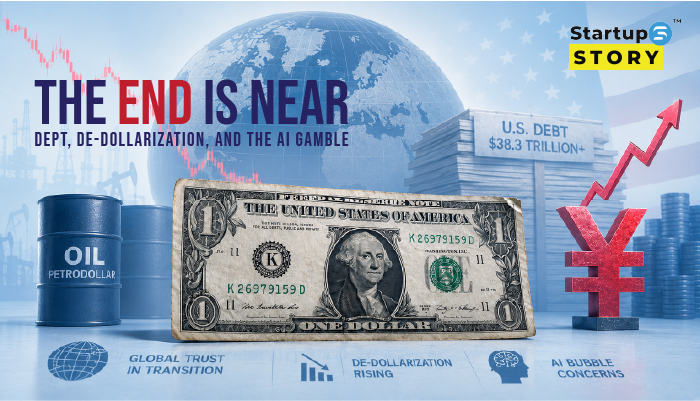
The global financial system has been built around the United States dollar for more than seven decades. Today, the U.S. national debt stands at over $38.3 trillion, making it the largest sovereign debt burden in absolute terms. Much of this debt is financed through U.S. Treasury securities, which are purchased by governments, institutions, and investors worldwide and are widely regarded as among the safest financial assets available.
The underlying logic of this system is almost elegantly circular: America borrows to pay interest on what it borrowed before, rolling debt forward in a seemingly endless recursive loop. Holding this loop together is the petrodollar system — the 1974 arrangement ensuring oil is priced and settled in dollars globally, creating a perpetual international demand for the greenback.
Saudi Arabia’s decision not to renew this arrangement, this historic decision allows the Kingdom to sell crude oil in multiple currencies—such as the Chinese Yuan, Euros, and Yen—officially moving away from the decades-old practice of trading oil exclusively in US dollars.
That threat is becoming increasingly real. India completed its first crude oil purchase from the UAE in rupees in 2023, while Brazil and China eliminated the dollar from their bilateral trade through a yuan-real settlement agreement. Indian refiners are now settling Russian crude in yuan and dirhams, bypassing the US dollar entirely. The BRICS bloc is quietly building a dollar-free trade architecture, transaction by transaction.
However, recent developments suggest that confidence in the system may be gradually weakening. U.S. Treasury yields have risen significantly in recent years, at times it hovers around 5%, reflecting investor concerns about inflation, fiscal deficits, and long-term debt sustainability and most importantly increase in the trust deficit of US government.
Simultaneously, alternative financial arrangements are emerging. The BRICS nations are exploring mechanisms to reduce dependence on the dollar, while countries such as the UAE have pursued energy trade agreements outside traditional dollar-centric frameworks. But the biggest challenge lies in the fact that India has officially declined the proposal for a unified BRICS currency. New Delhi is prioritizing its monetary sovereignty and is unwilling to compromise its control over financial policies by joining a currency bloc it fears would be dominated by China. This gives an edge to China making Petro-Yuan a reality and replicate the US debt financing model.
Some analysts believe that global capital flows indicate a shift in investor behaviour, with foreign institutional investors reassessing exposure to international markets and U.S. debt. At the same time, the United States is placing substantial faith in artificial intelligence as a future engine of economic growth. Yet questions remain about whether many AI companies can generate profits that justify their valuations. AI companies carry average revenue multiples of 23.4×, far above traditional benchmarks, and many startups remain unprofitable — with valuations far above their current revenues. It would not be wrong to say that there is an AI gamble.
The mismatch between investment and revenue is reminiscent of the dot-com era, where capital inflows far exceeded commercial output. Should the AI bubble burst, the selloff would not be contained — it would cascade across foreign investment and erode the last pillar of confidence in US financial leadership.
An America burdened by recursive debt, a weakening petrodollar, and a speculative tech economy faces a convergence of risks unlike any in its financial history.
Article researched and written by Mayank Sati

Follow Startup Story


Related Posts