
Three Chinese astronauts return to Earth after 90 days in space
- ByStartupStory | September 17, 2021
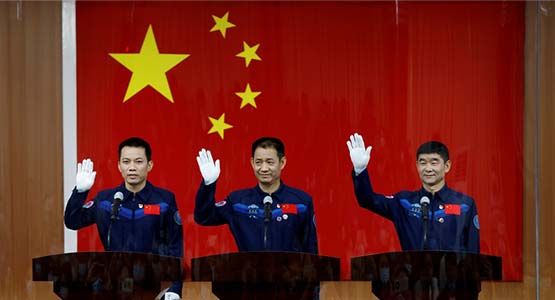
Three Chinese astronauts, after completing their three-month mission including two spacewalks and setting the Chinese record for the longest crewed spaceflight mission; returned to Earth after 90 days. “The return capsule of the Shenzhou-12 manned spaceship, carrying astronauts Nie Haisheng, Liu Boming and Tang Hongbo, touched down at the Dongfeng landing site in north China’s Inner Mongolia Autonomous Region,” the China Manned Space Agency (CMSA) said.
Earlier in the day, the official news agency, Xinhua, tracking the return, reported that the return capsule had entered the Earth’s atmosphere and its main parachute had been successfully deployed and its descent speed was slowing down.
The Shenzhou-12 return module separated from the propellant of the spacecraft at around 1pm local time; the propellant burnt down as it travelled through Earth’s atmosphere after it separated from the return cabin.
“The whole process was so smooth that Tang Hongbo was seen playing with a pen during the process of returning to Earth,” the Global Times said in a report.
“Real gold fears no fire,” Nie Haisheng joked with his fellow crew, citing a Chinese proverb as they re-entered the Earth’s atmosphere.
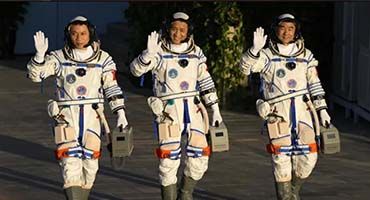
In June, China had launched the manned spacecraft Shenzhou-12 carrying three astronauts to work at an under-construction space station for three months, the longest stay in low earth orbit by any Chinese national.
It was China’s seventh crewed mission to space, the first during the construction of China’s space station, and also the first in nearly five years after the country’s last manned mission in 2016, state media reported.
Since 2003, China has launched six crewed missions and sent 11 astronauts into space, including Zhai Zhigang, who carried out China’s first spacewalk ever on the 2008 Shenzhou mission. On May 30, a cargo spacecraft carrying supplies including food and equipment docked with China’s first space station’s key module Tianhe as part of the preparation for the station to host three astronauts this month.
The unmanned Tianzhou-2, or “Heavenly Vessel” in Chinese, docked with Tianhe.
In recent months, China has returned rock and soil samples to Earth from the surface of the moon and landed a six-wheeled robot on Mars; it also landed a craft on the far side of the moon in 2019.
Once built, China’s space station will be the only alternative to the two-decade-old, US-led International Space Station (ISS), which may be retired in 2024.
The ISS – from which China is excluded – comprises Canada, Japan, the Russian Federation, the US, and 11 member states of the European Space Agency.

Follow Startup Story


Related Posts