
The Real Moat in Interior Design Isn’t AI. It’s the Pipeline.
- ByStartupStory | July 9, 2026

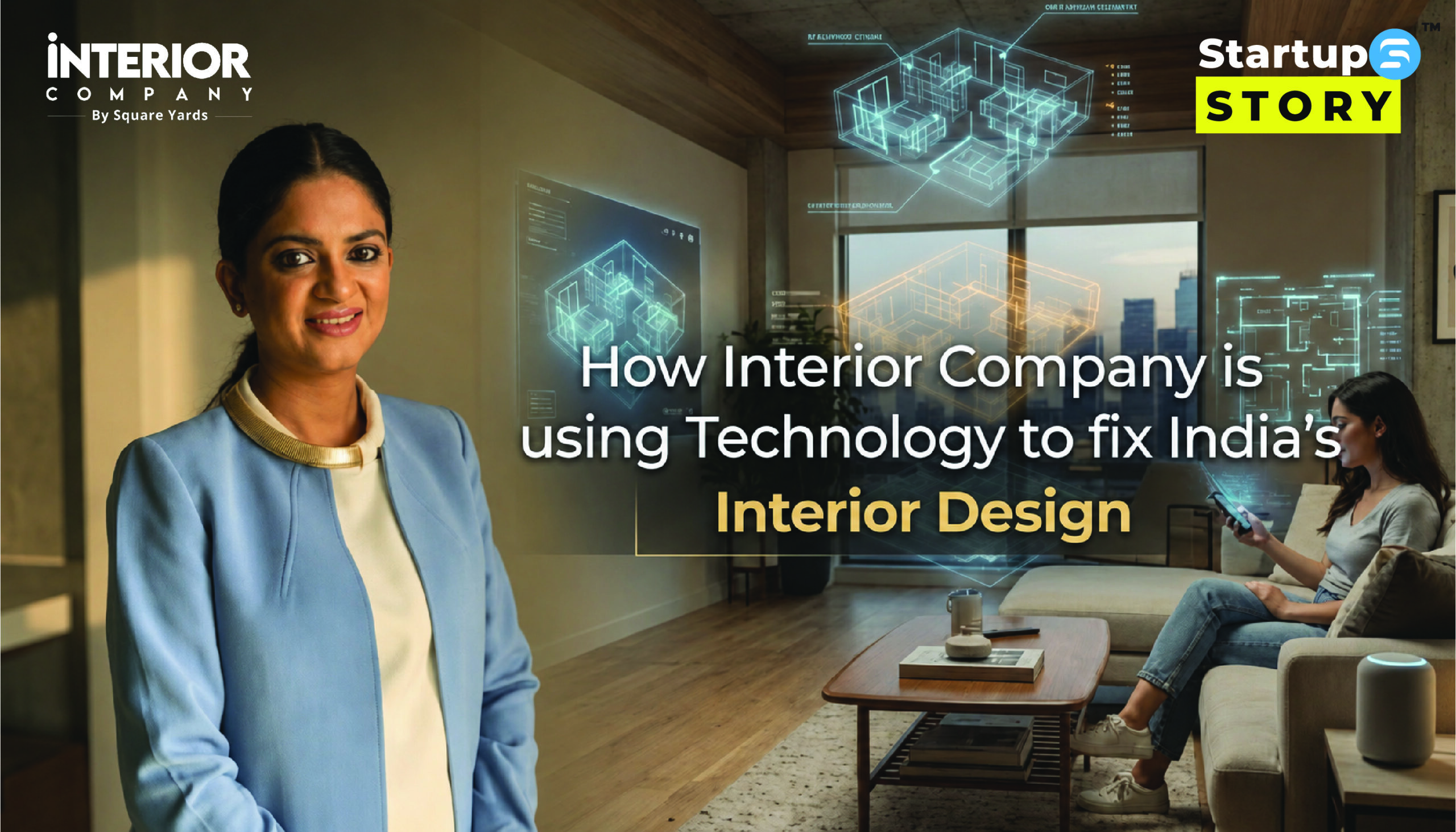
How Interior Company fixed India’s interior workflow
A customer picks her materials in a showroom in Gurugram. Three months later, the panel that arrives at her door doesn’t match what she approved. Somewhere between the showroom, the designer’s drawing, the BOQ, and the factory floor, her choice drifted.
This happens often enough in India’s organised interiors industry that it has a name inside the category, the handoff problem. Designers rotate off projects mid-way. Site measurements come back wrong. A stunning 3D render turns into an installation that looks nothing like it. A forty-five-day handover becomes ninety.
Every player in the category has tried to patch this with a better tool a smarter renderer, a faster CAD plugin, an AI add-on somewhere in the chain. Interior Company, the residential arm of the Square Yards group, made a different bet, Stop patching the chain and own it, end to end.
Building the Foundation Before the AI
Since 2022, Interior Company has been running its design operations on an in-house platform called Blocks, built on its own real-time 3D engine. Over FY25–26, the platform underwent its biggest upgrade yet not to add another flashy AI feature, but to strengthen the system behind every project.
The philosophy behind Blocks was simple: before AI can make workflows smarter, the workflow itself must work. Instead of managing design, pricing, drawings, quality checks, and manufacturing across multiple disconnected systems, Interior Company brought them together into a single connected platform. With that foundation in place, AI could move beyond generating ideas and start improving the entire journey from design to delivery.
How Blocks Brings It All Together
Every project inside Blocks lives in a single file the customer’s choice, the budget locked in during the mood-board phase, room geometry, BOQ, drawings, QC checks, right through to the factory’s panel breakdown. One record, not five.
That’s what lets the AI layer earn its keep instead of just decorating the process. Auto Furnish fills empty rooms with furniture that fits. The Auto Layout Engine turns a 3D model into fully dimensioned drawings days of draughtsman’s work, done in one step. AI DQC catches drawing errors before a reviewer opens the file, and flags what changed between versions. An upselling engine watches the BOQ live and surfaces upgrades with the cost difference attached.
Once a designer signs off, Blocks turns the design straight into manufacturing-ready panels and sends them to Interior Company’s own factories. No re-entering the design elsewhere. No gap between what was approved and what gets cut.
The Backing Behind the Bet
A multi-year platform investment of this scale isn’t the obvious move for a standalone interior brand competing for the next performance-marketing lead. Interior Company could take it on because of the group it operates within.
In FY26, Square Yards facilitated ₹13,236 crore in property transactions and disbursed ₹87,831 crore in home loans through Urban Money, and a large share of those transactions surface an interiors conversation at precisely the moment a customer is most receptive to it.
That distribution funded the build. It did not, on its own, create the moat.
The Numbers That Actually Mean Something
Design turnaround dropped from 42 days to 37. The more telling number is quality control, compressed by nearly a quarter from 9.4 days to 7.1 driven by AI DQC and the version comparer.
The QC team processed 36 percent more submissions in less time, while first-pass approval rates improved on the same cohort. Projects reaching the factory floor grew 35 percent year-on-year against an 18 percent rise in projects created the funnel improved in quality, not just volume. None of it required a proportional increase in designer headcount.
In interiors, faster usually means lower quality.
This year, Blocks did the opposite. Across 12,282 projects, we cut the median design timeline by twelve percent and compressed quality control by nearly a quarter simultaneously. You don’t achieve that by adding AI to a renderer. You achieve it by owning the entire pipeline. That is what we are now extending to the wider design industry,” says Kanika Gupta Shori, Co-founder and COO, Square Yards.
The Real Moat and Why They’re Opening It Up
The structural advantage isn’t the software. It’s what 12,282 projects generate in labelled signal approved designs versus revised ones, AI DQC flags a reviewer agreed with versus overruled, panels that matched design intent versus ones that didn’t. A foundation model can tell you what a wardrobe looks like. It can’t tell you which one a specific customer in a specific Gurugram 2BHK will approve, or which one breaks a manufacturing constraint on the shop floor. That’s workflow data, and it compounds every project makes it harder for a new entrant to catch up.
That’s exactly why Interior Company is now opening the stack. India’s interior design market is set to grow from roughly USD 35.5 billion in 2026 to over USD 65 billion by 2031, and the company is productising its internal tools as SaaS for the wider design ecosystem. The same data gets richer with more rooms, more cities, more briefs regardless of whose brand is on the invoice. Square Yards keeps feeding the in-house business; SaaS extends the advantage past it.
The chaos was never the thing to eliminate
Indian home interiors will always carry some execution chaos wrong site measurements, a customer who changes their mind after sign-off, a civil condition nobody accounted for. No software eliminates that.
What Blocks is built to do instead is absorb that chaos without losing the thread between what a customer approved in a showroom and what a machine cuts on a factory floor months later.
Most of the category is still bolting AI onto platforms built for a different era. Interior Company isn’t the biggest name in Indian interiors. It’s the one that finished building the floor everyone else is still standing on.
Renders sell homes. Pipelines deliver them.
Also Read


Follow Startup Story


Related Posts