Beyond 10-Minute Delivery: How NxtMeal Is Building the AI Operating System for Commercial Kitchens
- ByStartupStory | June 24, 2026

India’s food-tech sector has cycled through several defining battles restaurant aggregation, then cloud kitchens, now quick commerce, where companies compete on delivery minutes and investors fund the cash burn required to win that race.
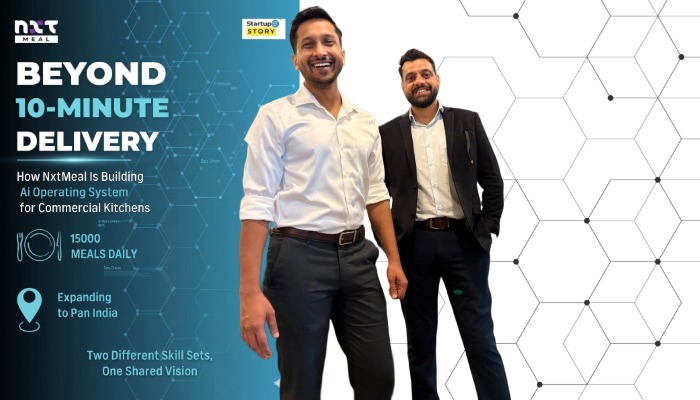
Milan Monappa and Sumeet Guleria opted out of that race entirely. Their focus has been on a part of the food industry that gets little attention, the commercial kitchen itself, and the procurement, planning, and production decisions that happen well before any delivery is initiated.
That focus built NxtMeal, a Bengaluru-based B2B food-tech company using AI to make commercial kitchen operations more predictable, efficient, and profitable at scale.
“While everyone is chasing 10-minute delivery, we are using AI to transform what happens inside commercial kitchens,” says Milan.
The B2B Gap Hiding in Plain Sight
NxtMeal wasn’t built on the first idea. Before kitchens, before AI, before any of it, the founders ran a straightforward consumer food delivery platform, their own app, their own riders, their own customer base. It looked, on paper, like every other food-delivery story being written in India at the time.
Then they came up against Zomato and Swiggy, and the math stopped working. Winning that race meant outspending companies with war chests built for exactly this fight, for years, with no guarantee of ever catching up, so they stopped running it.
What they found when they looked away from delivery was a market that had quietly outgrown its own infrastructure. Factories, tech parks, schools, hospitals, manufacturing units collectively feeding far more people every day than any food delivery app ever could, and doing it almost entirely on manual systems that hadn’t been touched in years.
Nobody was building for that market. That absence became NxtMeal opening.
Two Founders, Two Skill Sets, One Shared Vision
NxtMeal founding team reflects a deliberate division of expertise.
Milan Monappa, Co-Founder and CEO, built the company’s technological backbone the AI systems and infrastructure that let kitchens run on data instead of estimation.
Sumeet Guleria, Co-founder and COO , brings operating experience from scaling high-growth companies including Swiggy, OYO, and Jumbotail, contributing expertise in enterprise sales and the operational discipline needed to expand quickly without losing control of quality.
That complementary split mattered, because what they kept encountering across kitchens was the same gap: decisions on inventory, forecasting, and procurement still ran on manual estimation rather than data. As operations scaled, the gap widened wastage increased, consistency dropped, margins grew harder to defend.
For Milan and Sumeet, that wasn’t a people problem. It was a systems problem, and one they believed technology was built to solve.
The AI Layer Powering the Future of Commercial Kitchens
Artificial intelligence is most commonly associated with software and consumer-facing tools. NxtMeal applies it to a more physical environment, the kitchen floor itself.
The company has developed proprietary systems that forecast demand, calculate ingredient requirements, optimise production planning, and monitor operational efficiency in real time. Rather than relying on a kitchen manager’s estimation, the platform analyses historical consumption data to determine what should be prepared, how much inventory is required, and where costs are at risk of slipping.
The result, according to the founders, is a level of consistency that the traditional catering and dark-kitchen model has historically struggled to deliver performance that holds steady regardless of which kitchen, or which manager, is operating on a given day.
Beyond Catering: Creating a Full-Stack Food-Tech Ecosystem
What began as an internal operational tool has evolved into a broader software offering. Alongside its AI infrastructure, NxtMeal has developed ordering systems, queue management tools, kitchen management platforms, and workflow automation products now being adopted by operations beyond Also use NxtMeal own kitchens, creating a second revenue stream independent of catering.
This is central to how the founders frame the company’s long-term identity. NxtMeal is not positioning itself solely as a catering business, but as a Food AI platform with the potential to power kitchen operations it does not directly own.
Scaling From Bengaluru to the Next Phase of Growth
NxtMeal currently operates 6 kitchens across Bengaluru, serving approximately 15,000 meals daily. The company generates close to ₹2 crore in monthly revenue.
The expansion roadmap is built across two fronts. In Bengaluru, NxtMeal plans to scale from 6 kitchens to 15 over the next two years. Simultaneously, the company is entering Hyderabad with two kitchens by December, its first move outside Bengaluru, taking the AI-driven kitchen model into a new city for the first time.
On the technology side, NxtMeal has built its own ordering, queue management, and kitchen management systems software products that now stand apart from the core catering business and have started generating revenue of their own, a stream the founders intend to grow alongside the kitchen expansion.
The Bet Behind the Bet
Most of food-tech is still asking the same question: how fast can a meal reach someone? Milan and Sumeet asked a different one, what if speed was never the real problem? What if the bigger opportunity was never in the last mile at all, but in the kitchen everyone walked past to get there?
That bet is what NxtMeal is built on. Not a faster way to deliver food, but a smarter way to make it forecasting demand before it happens, catching waste before it adds up, holding quality steady across a kitchen network that keeps growing. It’s a quieter kind of disruption, the type that doesn’t show up in a delivery-time notification, but shows up every time a meal is consistent, on time, and priced right.
While the rest of the industry keeps racing toward the customer’s door, Milan Monappa and Sumeet Guleria are still standing in the kitchen, convinced that’s where the real food-tech story was always meant to be written.


Follow Startup Story


Related Posts