MDR: A New Friction Point for India’s Digital Economy
- ByStartupStory | September 28, 2026
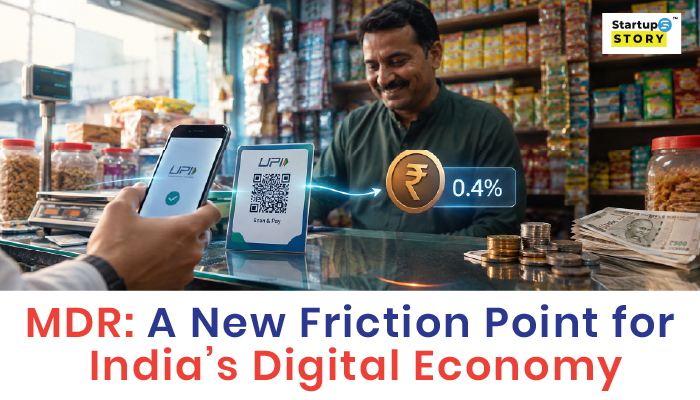
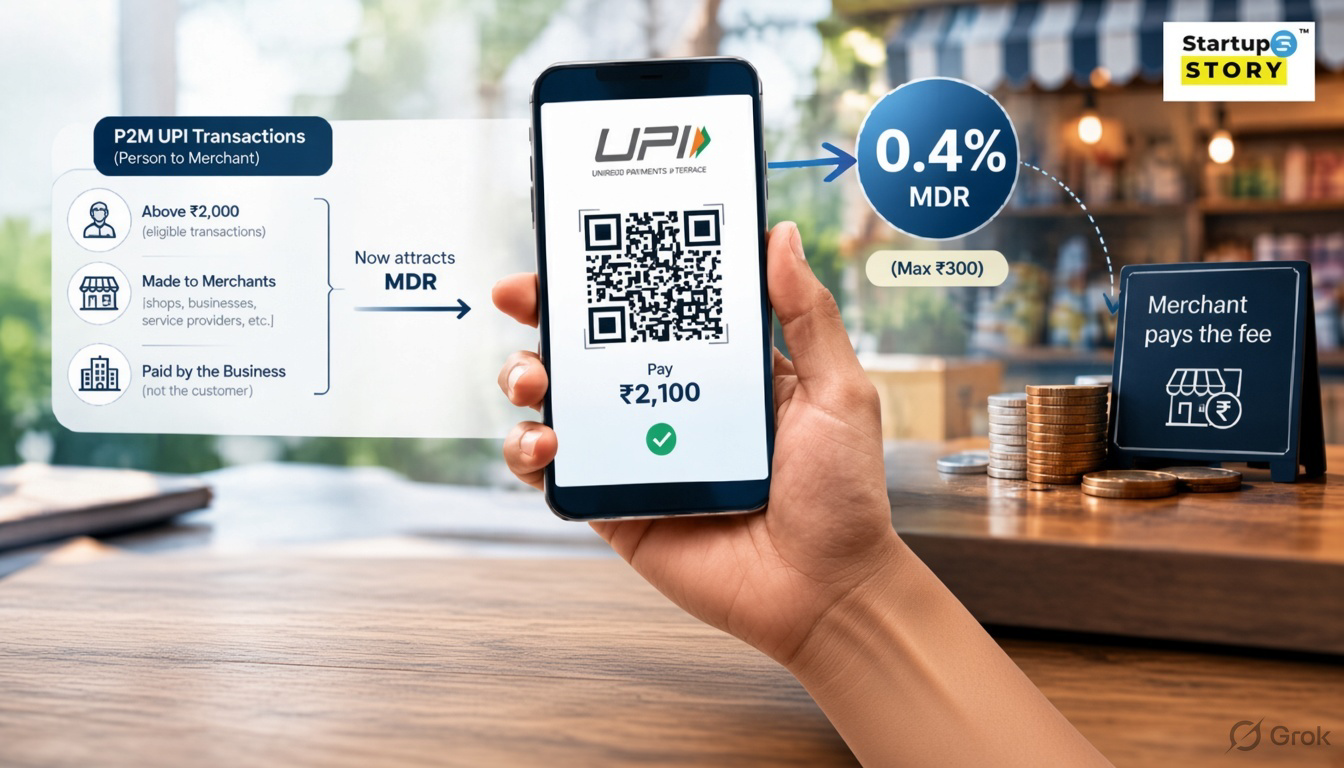
For a decade, UPI has been India’s quiet revolution. From a small vendor in almost any part of the country to a showroom in a premium market such as Khan Market, the same system has made payments instant and, for customers, free. From October 15, however, the economics of some UPI transactions will change. A Merchant Discount Rate (MDR) of 0.4% will apply to eligible person-to-merchant UPI payments above ₹2,000, subject to a maximum charge of ₹300 for transactions of ₹75,000 or more. Certain sectors such as fuel, railways, telecommunications, insurance and agricultural inputs will instead face a flat ₹5 MDR on qualifying transactions. Person-to-person transfers will remain free, and the government has said that customers will not directly bear the MDR. Small merchants covered by the P2PM framework and receiving up to ₹1 lakh a month through UPI will also remain exempt.
Start with the basic logic. Processing a UPI payment does not necessarily become proportionately more expensive as the transaction value rises. The digital message, payment infrastructure and settlement process do not become four times as costly simply because a customer pays ₹20,000 instead of ₹5,000. Supporters of the new MDR point out that 0.4% remains well below the rates commonly associated with credit-card acceptance, and that comparison is valid. But UPI’s most important historical competitor was not Visa, Mastercard or American Express. It was cash.
The question, therefore, is not simply whether 0.4% is cheap compared with cards. It is whether introducing a percentage-based charge on a system that helped move millions of transactions from cash to digital payments is justice for merchants.
Nor is the ecosystem starved of money. The RBI approved a record surplus transfer of about ₹2.87 lakh crore to the government for FY26. NPCI, meanwhile, reported operating revenue of about ₹4,240 crore and surplus before tax of roughly ₹1,888 crore in FY26; its marketing expenditure was around ₹1,420 crore. Listed Indian banks, taken together, reported consolidated net profit of more than ₹4 lakh crore in FY26. These figures do not by themselves prove that UPI does not need a sustainable revenue model, but they do raise a legitimate question about how the cost of maintaining and expanding the ecosystem should be distributed.
The merchant can be the weakest link. Retail margins in India vary considerably by product and format, but many grocery and general-trade businesses operate with relatively thin margins. Kirana stores operate on tight gross margins of 10–13%, these small retail shops remain highly resilient because they offset low margins with exceptionally high asset turnover and minimal operating costs. Petrol dealers have cited margins of roughly 0.5% on diesel and around 0.75% on petrol. For such businesses, even a seemingly small payment-processing cost can matter, particularly when it applies repeatedly to high-value transactions. The MDR will also attract 18% GST, although eligible registered businesses can generally claim input tax credit, so the entire GST amount should not automatically be treated as a permanent additional cost.
Retail margins also vary sharply across countries and sectors, India’s large general-trade operate on a very different cost and margin structure from many large organised retailers in developed markets and thus UPI played an important role in bringing small merchants into the formal digital-payment ecosystem. If the economics of accepting digital payments become less attractive, some merchants may respond by encouraging cash, particularly for larger transactions.
Another important aspect is mutual-fund payments. Capital-market transactions, including payments relating to mutual funds, securities, stockbrokers and dealers, will attract a separate MDR of 0.02%, capped at ₹300 per transaction. More importantly, recurring UPI AutoPay and mandate-based payments, including mutual-fund SIPs, are not subject to the prescribed MDR. Therefore, the impact on regular SIP investors using UPI AutoPay should be limited under the current framework. The potential cost issue is more relevant to one-time mutual-fund purchases and other capital-market payments made through UPI.
UPI for mutual funds has been gaining popularity through digital investment platforms, enabling retail investor to invest in direct mutual-fund plans over the regular ones. The new cost structure could therefore create a modest additional expense for platforms and asset managers handling one-time UPI payments. Whether these businesses absorb that cost, negotiate different arrangements with payment providers or eventually alter their pricing models remains to be seen. It would be premature, however, to conclude that the new MDR will force platforms into an annual subscription model.
The levy is also worth examining in the context of the wider savings created by digital payments. Every payment that moves electronically rather than through physical currency can reduce some of the costs associated with printing, transporting, handling and securing cash. Digital payments also leave money within the formal banking system. These are genuine economic benefits, although they do not automatically translate into direct fee income for the banks, RBI or NPCI. The stronger argument is therefore not that UPI has literally “paid for itself”, but that its benefits extend beyond the revenue earned from individual transactions.
The deeper concern concerns credit. One of UPI’s important developments has been the ability to use RuPay credit cards on UPI for merchant payments. This allows millions of consumers to access short-term credit through the familiar QR-code payment infrastructure and gives merchants access to credit-card customers without requiring a traditional card terminal.
In a cash-constrained country, credit changes what a household can afford. Spending lifts consumption, and consumption pulls production and jobs along with it. The government has sensibly kept credit-linked UPI outside the new 0.4% framework.
But policy on paper and behaviour at the counter are not always the same. A shopkeeper who decides that high-value digital payments are not worth the cost may not distinguish between different UPI funding sources at the point of sale. If merchants begin refusing high-value UPI payments altogether, the acceptance network for credit-linked UPI could also be affected.
This could become a problem for discretionary consumption. High-value UPI transactions are a relatively small share of P2M transaction volume, but they represent a much larger share of transaction value. Government data indicates that only about 4% of P2M UPI transactions in FY26 were above ₹2,000, yet those transactions accounted for close to two-thirds of P2M payment value.
If some merchants respond to the MDR by encouraging cash or refusing larger UPI transactions, discretionary purchases in Tier-I and Tier-II cities could face additional friction. Whether that ultimately reduces consumption will depend on how extensively merchants and consumers change their behaviour after October 15.
There are already signs of resistance. Petrol dealers in Madhya Pradesh have announced that they will stop accepting UPI payments above ₹2,000 from October 16, citing the additional cost of MDR. Similar concerns have been raised by petrol dealers in other states. The issue is particularly sensitive for fuel retailers because their margins are narrow and the government has fixed a special ₹5 MDR for qualifying fuel transactions above ₹2,000.
The stakes are large. UPI processed about ₹314 lakh crore in FY26. While only around 4% of P2M transactions exceeded ₹2,000, those transactions represented roughly two-thirds of P2M transaction value. This means the new framework is aimed at a relatively small portion of transactions by number but a significant portion of the value flowing through merchant payments. These include larger grocery purchases, appliances, education-related payments, medical expenses and other household spending.
Another important aspect is fintech lending. Companies such as Paytm and BharatPe have built financial-services businesses around their payment’s relationships with merchants. Transaction history, payment volumes and cash-flow patterns can help lenders assess the financial behaviour of small businesses. Paytm, for example, says its lending partners use merchants’ transaction history and payment activity in underwriting working-capital loans, while BharatPe has described the use of transaction volume and frequency in determining merchant borrowing capacity.
If some retailers move a greater share of their transactions back to cash, the digital transaction history available to lenders could become less complete. That does not mean merchants will automatically become ineligible for loans, but a reduction in digital payment data could make cash-flow-based underwriting less informative. It could also affect the economics of fintech companies that use payments as a distribution channel for lending and other financial services. This is particularly relevant as several fintech businesses are now moving toward sustainable profitability; Paytm, for example, reported its first full-year profit in FY26.
Economic disruption rarely arrives through one dramatic decision. More often, it comes through a series of small frictions that make everyday transactions slightly more expensive, less convenient or less predictable. The new UPI MDR is one such friction. India built one of the world’s largest digital-payment ecosystems by making payments simple, interoperable and inexpensive. The challenge now is to introduce a sustainable commercial model without weakening the very merchant acceptance and consumer behaviour that made UPI successful in the first place.
Article researched and written by Mayank Sati

Follow Startup Story


Related Posts