The New Era of Shopping raises $1.4M Pre-Seed to help brands win in the age of agentic commerce
- ByStartupStory | February 25, 2026
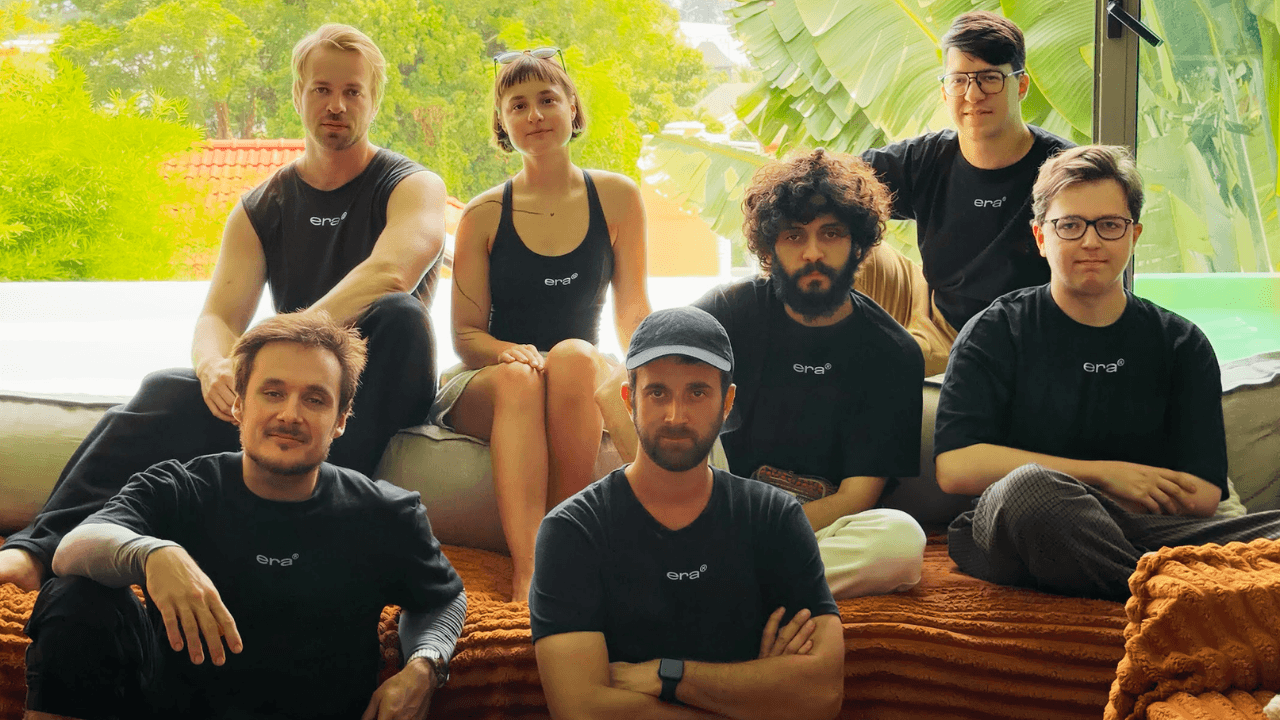
The New Era of Shopping today announced the close of a $1.4 million Pre-Seed round to help traditional brands become discoverable, trusted, and purchasable inside AI assistants and agent-driven shopping experiences.
The investment was co-led by a European VC firm Presto Ventures, and an NYC-based AI accelerator Alliance, with participation of a16z Scout Fund, a super angel and a founder of ZFellows Cory Levy, AI-focused fund Davidovs VC, Ukrainian VC hi5 Ventures, Japanese Rokubunnoni, early-stage Typhon VC, and a group of angels: Greg Tkachenko (Unreal Labs), Guillaume Roux-Romestaing (Wordware), Kacper Kielak (Magic), Andrei Nenadov, Quinn Campbell, Urvit Goel, Evgeny Yurtaev, Nicole Buss, Matthieu Tissot, and Zituo Chen.
The storefront is moving into the chat window
Today, millions of shoppers are abandoning traditional keyword searches in favour of direct answers from AI assistants, and the storefront is moving into the chat window.
Roughly 5 per cent of consumers ask AI chatbots what to buy instead of browsing online stores. Industry projections suggest that figure will reach 15 per cent by 2027 and could exceed 50 per cent within two years after that.
When AI agents become the buyer
Agentic shopping describes a new shopping lifecycle in which AI agents — acting on user preferences, history and explicit prompts — discover products, request checkout authorisation, and complete purchases on behalf of people.
The Agentic Commerce Protocol and related platform tooling are lowering the bar for both agents and merchants to transact programmatically, and instant checkout inside assistant experiences is already live in early platforms.
Era is an agentic commerce platform that helps brands make their product catalogues discoverable, trusted, and purchasable inside AI answer engines — including ChatGPT, Google AI Mode, and Perplexity.
By combining catalogue sync, AI visibility analytics, competitive intelligence, and prompt-level demand research in one platform, Era gives merchants the infrastructure to compete in the next generation of e-commerce. “If you’re not optimised for AI, you don’t exist”
I spoke to Era co-founder and CEO Oleksii Sidorov, who told me that in the old era, being on the second page of Google was bad. In the new era, if your product metadata, content, and flows aren’t optimised for AI agents, you don’t exist.
“We built Era so that every brand, not just the ones with large engineering teams, can be present and purchasable wherever consumers are asking to buy.
The future of commerce is being written right now, and we are here to make sure our merchants are in it.”
Key features of Era’s platform include two-way catalogue syncing with PIMs/ERPs, SKU-level intelligence to measure AI visibility and product ranking in LLM responses, user prompt analysis for trend and volume insights, and automated content optimisation to improve how products rank in conversational answers. The product is already integrated with all major eCommerce platforms, including Shopify, WooCommerce, Magento, BigCommerce, Wix, etc., as well as the main AI discovery platforms: ChatGPT, Gemini, Claude, Google AI Mode, and Perplexity.
The company is currently running pilots with the first cohort of brands and will use the Pre-Seed to expand pilots with the Enterprise segment, scale data infrastructure, and integrate new platforms.
Why brands aren’t moving fast — yet
Pilots so far have revealed that, even though this seems like an obvious edge, not every brand is rushing to capture it. Sidorov explained:
“E-commerce brands especially are still conservative — they’re busy with channels that already work, and a lot of them genuinely have no idea what’s going on in AI search. Enterprises are particularly slow-moving. Where it’s been easier is with tech startups and software companies.
They’re more AI-literate; they use LLMs themselves to find tools and write code, so they immediately understand the value.
We’ve broadened our focus as a result — we don’t limit ourselves to e-commerce anymore. Any brand that benefits from online traffic is a potential client.”
According to Sidorov, there are already companies that exist almost entirely on AI traffic — they happened to be well-indexed by accident, and now that’s where most of their traffic comes from.
Two YC alumni bet on agentic commerce
The company was founded by a team with deep experience at the intersection of AI, eCommerce, and advertising.
Between them, the two co-founders have been through Y Combinator twice — and sold two companies.
Ukrainian-born Sidorov previously conducted AI research at the University of Oxford and Meta AI Research before pivoting into entrepreneurship. He first founded Suggestr, an AI-driven e-commerce startup accepted into Y Combinator’s Winter 2022 cohort.
He later launched two additional ventures — Slise (advertising analytics) and Dise (an AI-native CRM) — both of which were acquired. Much of this was built while relocating across Europe after fleeing Russia’s full-scale invasion of Ukraine and supporting family back home.
Sidorov studied in Ukraine, then continued his education across Europe through Erasmus, moving from physics into computer science and eventually AI. He worked in Belgium and Oxford, built a research track record, and then joined Facebook AI Research right after my master’s.
He moved to Silicon Valley and followed a very academic path — conferences, papers, internal research.
“But when COVID hit in 2020, I realised I wanted to build something tangible. I had deep expertise in AI, but I wanted to apply it in the real world — not just write papers. Being in Silicon Valley definitely reinforced that instinct.”
His first startup, Suggestr, sat at the intersection of AI and e-commerce.
“We joined YC Winter ’22, which was an incredible experience. Suggestr was an AI recommendations engine that brought Amazon-level personalisation to smaller e-commerce brands.
We worked with more than 100 brands and generated over half a million dollars in additional sales for customers.
But ultimately, we felt the market was too small to scale to the level we envisioned. So we made the hard decision to shut it down and start again.”
The next venture was Slise, a Web3-based media analytics company built on blockchain data, which was acquired in a full exit, including IP and clients. While building Slise, Sidorov identified another gap — this time in Telegram-based sales infrastructure.
“In crypto, especially, a lot of deals happen on Telegram, but there wasn’t proper tooling for sales teams. So we built Dise, an AI-native CRM for messenger-based sales. It gained traction, but by 2025, we stepped back and asked ourselves: Why are we building a niche SaaS for Telegram when AI is reshaping the entire internet?
We sold it and redirected our focus toward what we believed was a much larger opportunity — AI-driven search and product discovery. That became ERA.”
His co-founder and CTO, Sergey Drozdkov, is a serial founder and CTO with more than 12 years of experience in software development and AI. As CTO of Sensorium, he built one of the first AI chatbots two years before ChatGPT’s release, and later went through Y Combinator’s W23 cohort with one of the first AI sales agents, Intently AI.
Hype vs reality in AI commerce
Given his research background, I was curious how Sidorov sees AI platforms changing the way people shop. He admits, “I’m genuinely sceptical of the hype. What’s already happening is real but still early. You can now buy products directly through ChatGPT in the US without ever visiting a merchant’s website. The orders still flow to the merchant on the back end, so they receive the data and fulfil it — but the customer experience is increasingly detached from the brand’s storefront.”
He asserts that there are good arguments that, in five to ten years, as we now ask AI assistants questions instead of Googling and exploring links, people will also use them to find and buy products.
“Especially when you consider that ChatGPT already stores your payment information and remembers your address — it’s becoming a one-click experience. But this varies a lot by category. Food and beverage, you don’t think much about. But supplements, personal care, health-related products — you want to compare specific ingredients, formulas, dosages, pricing. You don’t care what the packaging looks like.
That’s where chatbots are genuinely efficient.”
Reputation as a ranking signal In terms of customer brand relationships, the retail shift represents a substantial change. Sidorov contends that when someone buys through ChatGPT or Google Shopping, they’re not really thinking about which brand or store they’re choosing.
“So the traditional levers — beautiful storefronts, brand storytelling, direct customer relationships — become less powerful. What matters now is your internet footprint: your reviews, your content, your references, what AI crawlers can find and interpret about you.”
However, the upside is that once you build that reputation, it’s more durable than paid ads. But the downside is you can’t change it overnight, and the ranking factors shift constantly.
“Six months ago, Reddit was enormously influential on LLM outputs,” explained Sidorov. “Then it dropped off. Now, HTML structure and other signals matter more. It’s nearly impossible for one marketing manager to keep up with all of that — which is why we exist.”
In the AI era, discoverability is no longer about search rankings — it is about being legible to machines that decide on behalf of humans. Era is betting that brands will need infrastructure, not intuition, to compete in that world.
Follow Startup Story


Related Posts