The Architecture of Audacity: How Ink In Caps (IIC) Built a Global Innovation Engine Without a Single Cent of VC Money
- ByStartupStory | February 17, 2026

In the folklore of the modern startup era, the narrative arc is almost always the same: a pitch deck, a seed round, a series of increasingly frantic “burn” phases, and the hope of an exit before the unit economics catch up. It is a story of speed over sustainability.
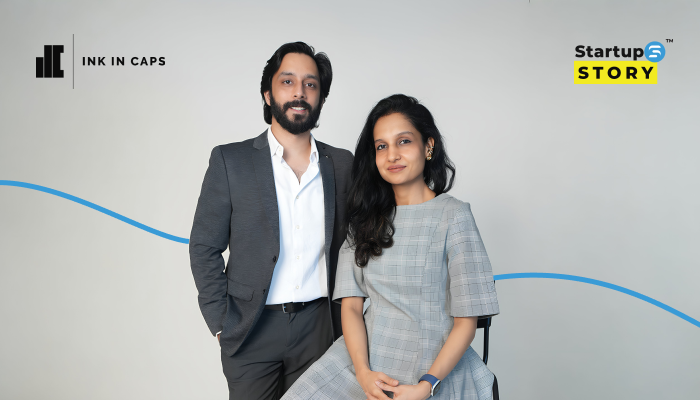
But in a quiet corner of the Indian tech landscape, Manish Kakkar and Snigdha Singh are authored a different kind of script. Their company, Ink In Caps (IIC), is the antithesis of the venture-funded bubble. It is a story of the “audacity of nineteen” meeting the high-stakes precision of Milanese luxury design. It is a story of a 160-member powerhouse that has maintained a staggering 92% CAGR while being profitable from day one.
This isn’t just a business success story; it is a blueprint for the next era of Indian entrepreneurship – one where India moves from being the world’s “back office” to its primary architect of innovation.
The Genesis: A Living Room and a Laptop
Every revolution begins with a refusal to accept the status quo. For Manish Kakkar, that refusal manifested early. At 19, an age when most are still navigating the theoretical frameworks of university, Manish was operating from his parents’ living room.
Equipped with a single laptop and a vision that far outpaced his resources, he didn’t set out to build a traditional agency. He set out to solve the gap between what technology could do and what businesses actually needed.
The trajectory of IIC shifted from a promising solo venture to a formidable innovation engine when Snigdha Singh joined the mission. Snigdha brought a pedigree that is rare in the chaotic world of tech startups: the disciplined, high-stakes environment of luxury design studios in Milan. This fusion – Manish’s raw entrepreneurial audacity and Snigdha’s architectural precision – created the unique DNA of Ink In Caps. They weren’t just “coders” or “creatives”; they were solution architects.
The Bootstrap Manifesto: Growth Without the Crutch
To understand the significance of IIC’s growth, one must look at the climate in which they scaled. In an ecosystem where “valuation” is often confused with “value,” IIC chose the harder path: Bootstrapping.
By refusing venture capital, Manish and Snigdha retained something more valuable than cash- autonomy. This independence allowed them to focus on the “logic” of the business rather than the “optics” for the next board meeting.
The Numbers That Defy the Norm
Scale: From a duo in a living room to a 160+ member multidisciplinary team.
Velocity: A consistent 92% Compound Annual Growth Rate (CAGR).
Stability: Profitable from day one, ensuring that every hire and every expansion was funded by the value they created for clients, not by investor debt.
Solving Existential Problems: Beyond the Gimmick
In the early days of immersive technology (AR/VR/XR), many agencies fell into the trap of selling “gimmicks” – flashy demos that looked good in a presentation but gathered dust in practice. IIC took the opposite approach. They looked for existential business problems that traditional media couldn’t solve.
1. Dismantling “Range Anxiety” for BMW
When BMW looked to penetrate the Indian electric vehicle (EV) market, they faced a psychological wall: Range Anxiety. Consumers were hesitant to commit to a future they couldn’t visualize. IIC stepped in not with an ad campaign, but with Bevscape.
By creating a technical, immersive ecosystem that allowed users to interact with the EV infrastructure and understand the vehicle’s capabilities in a tangible way, IIC moved the needle from “curiosity” to “conversion.” They didn’t just show a car; they dismantled a fear.
2. Selling the Unbuilt: V-Estate
In the high-stakes world of real estate, the product—the luxury apartment or the commercial complex – often doesn’t exist physically for years. Giants like Godrej, Adani, L&T, and Rustomjee faced the perennial challenge of selling a dream based on a 2D brochure.
IIC’s V-Estate changed the rules of engagement. By deploying high-fidelity, interactive environments, they allowed potential buyers to walk through their future homes before the first brick was laid. This wasn’t just “virtual reality”; it was a sales engine that brought architectural precision to the customer’s fingertips.
The Pivot to Proprietary SaaS: V-Retail
If the first decade of IIC was about mastering service-based innovation, the next chapter is about productization. Their recent shift into proprietary SaaS with V-Retail marks their evolution into a global tech player.
V-Retail is an AI-driven sentiment engine. In an era where data is the new oil, V-Retail provides the refinery. It goes beyond clicks and heatmaps to analyze the psychological and emotional triggers of consumers in a retail environment. By understanding how a consumer feels while interacting with a product, brands can pivot their strategies in real-time. This move proves that Manish and Snigdha aren’t just creators- they are data-driven strategists building the tools of tomorrow.
Setting the Global Standard: From Monza to Qatar
For decades, the global perception of Indian tech was focused on outsourcing – the “back office” that maintained the world’s code. IIC is at the forefront of changing that perception. They have proven that Indian-built tech doesn’t just meet international standards; it sets them.
Their execution record is a testament to this global dominance:
F1 in Monza: Providing high-precision tech for the fastest sport on earth.
FIFA in Qatar: Engaging millions of fans on the world’s biggest stage.
Glenmark in the US: Navigating the complex, highly regulated waters of the American pharmaceutical industry with sophisticated digital solutions.
When Manish and Snigdha take a seat at the table in Milan, New York, or Doha, they aren’t there as “vendors.” They are there as partners who bring a unique blend of Indian resourcefulness and European design discipline.
The “IIC Way”: Better Questions, Better Results
What can other founders learn from the IIC story? It boils down to a fundamental philosophy: Trade creative chaos for architectural precision.
Manish and Snigdha have built a culture where “the question” is more important than “the answer.” Instead of asking, “How can we use AR for this brand?” they ask, “What is the core friction in this customer’s journey, and how can technology remove it?”
They have proven that you don’t need a massive burn rate to acquire talent or a flashy office to win global contracts. You need a relentless focus on the logic of the problem and the audacity to believe that a small, focused team from India can out-think the giants.
The Future: The Vanguard of Immersive Tech
As we move toward a more decentralized, AI-integrated, and immersive web, the “solution architects” will inherit the earth. Ink In Caps is already there.
From their humble beginnings in a living room to their current status as a global powerhouse, Manish Kakkar and Snigdha Singh have remained grounded in their core values:
Profitability as Freedom: The ability to say “no” to the wrong projects and “yes” to the future.
Design as Strategy: Technology is only as good as the human experience it facilitates.
Impact over Optics: Real success is measured in CAGR and client results, not headlines and hype.
Ink In Caps is not just a company; it is a movement. It represents a new generation of Indian entrepreneurs who are confident, self-funded, and world-class. They are the architects of a new reality, proving every day that with the right logic and enough audacity, you can build the future from anywhere.
Discover the IIC Innovation Engine
Are you ready to stop using tech as a gimmick and start using it as a solution?
Watch how IIC is redefining global immersive tech: > Explore the IIC Lab

Follow Startup Story


Related Posts