Rajeev Chandrasekhar says the digital economy is set to grow in 2023
- ByStartupStory | January 2, 2023
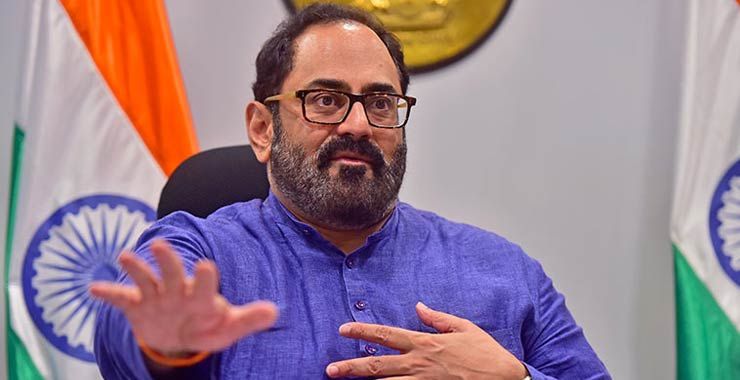
IT Minister Rajeev Chandrasekhar has stated that India’s digital prowess will increase in 2023 and over the following five years, driven by technology, start-ups, semiconductors, electronics, and computing, allaying any fears about a tech winter and forecasting spring for the nation’s thriving innovation ecosystem.
The West’s economic slowdown, a recent wave of layoffs by US IT firms, market volatility, and predictions of a tech winter make the IT minister’s remarks noteworthy.
The Minister of State for Electronics and IT, Chandrasekhar, told PTI that there are still “extremely strong” domestic and international potential for digitalization. He oozed assurance, saying that the aim of a trillion-dollar digital economy for India is “clearly within our grasp” and “an absolutely undeniable actuality.”
He declared that the momentum of the digital economy would continue in 2023, supported by enabling laws and regulations that provide a foundation for technical advancement and innovation.
It is important to note that while India has strengthened IT regulations for social media and digital users’ security and development on a new data protection law has begun, the rules for online gaming and the general framework of the draught Digital India Act are anticipated to be released soon.
“We see no winter…if anything, it is summer and spring for the next five years,” Chandrasekhar asserted, citing the tech potential. He noted that there is still a high need for both Indian talent and goods and technologies that are created in India and manufactured there.
“India as a market for consuming digital products and digital services is one of the biggest markets for the next 5-10 years. So all these (factors) point to India continuing its digital economy expansion to reach one trillion dollars in the next 4-5 years,” Chandrasekhar said.

The minister asserts that despite occasional corrections, innovation and the startup impetus would continue. The minister pointed out that enterprises must simultaneously adapt new business models and upskill their employees in order to remain competitive in the face of market changes.
He warned that companies that do not innovate quickly or adapt to changes may face difficulties “connected to their own preparedness for this digital opportunity, not produced by the market.”
“…that trillion dollar digital economy is well within our grasp, and that we have a very reasonably high opportunity to reach the trillion dollar digital economy, firing on all cylinders, is an absolutely incontrovertible fact,” Chandrasekhar said. India has made great strides since 2014, when its digital prowess was limited to IT and services supported by IT, diversifying its economy, and entering new markets.
While the IT and ITES sector is now growing at a rate of 15-20% annually, there is also a top-notch startup and innovation ecosystem. While India has established itself as a production powerhouse in the electronics manufacturing industry, other emerging sectors such as deeptech innovation, semiconductor design, electronics design, blockchain, supercomputing, open compute initiative, automotive, and 5G will also make significant headway in 2023.
“In the coming five years, all these will continue to chug along at high rates of growth,” Chandrasekhar said adding these new and emerging areas will attract investments, create digitalisation products, and services opportunity for the country.
“In those five years, will there be some corrections? Yes, this is the nature of tech…because tech is so disruptive and changes are so rapid, a company that was doing, say, something in the classic ‘Web2’ area, will find itself totally irrelevant in the ‘Web3’ space 1-2 years fr
Follow Startup Story


Related Posts