Beyond the City Limits: How GoFresho Is Building Modern Retail for Rural Andhra Pradesh
- ByStartupStory | June 25, 2026
India’s retail industry has spent the last decade fighting variations of the same battle, first organised supermarkets, then quick commerce, companies competing on speed, convenience, and choice, almost entirely within city limits.
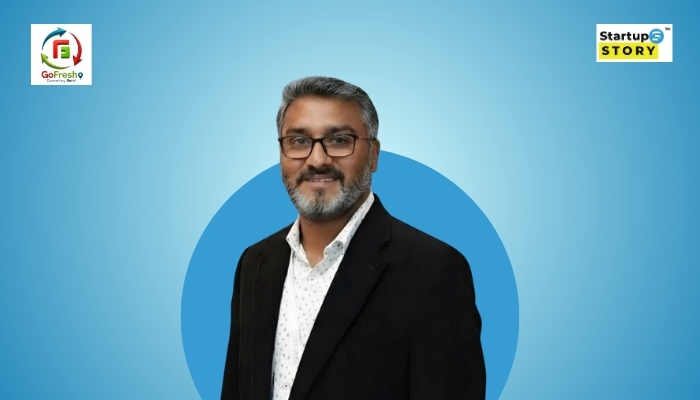
Naresh Vadday an MBA graduate from Chennai University opted out of that race entirely. After nearly two decades in retail leadership roles at companies including Tata and Samsung and Airtel, almost all of it focused on urban consumers, his attention shifted to a part of India’s retail story that gets almost no attention: small towns and villages where modern retail never properly arrived in the first place.
“I always felt there was a huge gap in the shopping experience for daily essentials in these towns, not just availability, but the quality of products and the prices people were paying,” says Naresh.
That gap became GoFresho, a retail company building large-format supermarkets in deep rural Andhra Pradesh, starting with a single store in East Godavari district in 2020.
The Rural Retail Gap Nobody Was Solving
Naresh’s career had been built almost entirely in cities. Heading retail divisions in telecom, customer experience was always the problem he was paid to solve, for shoppers who already had supermarkets, delivery apps, and competing retail chains fighting for their attention.
What stayed with him wasn’t a problem inside those cities. It was a market a few hundred kilometres away that nobody in organised retail was building for at all. Towns and villages with populations of 10,000 or more had the same daily needs as any urban household, groceries, FMCG, household essentials, but almost none of the retail infrastructure to meet them.
Prices were often higher than what the same products cost in cities, despite lower incomes.
Quality was inconsistent. And the shopping experience itself, for most people, meant a small kirana store with limited stock and no real alternative nearby.
Nobody was building for that market. In 2020, Naresh decided he would.
Retail Built for Rural Economics, Not Urban Ones
GoFresho’s model exists because large retail chains can’t make the economics work in markets like in Rural Mandal Head Quarter villages of East Godavari, and the company was deliberately structured to do what they can’t.
Big-format players typically operate on standardised store formats, urban-scale overheads, and manpower costs built for cities, a cost structure that simply doesn’t survive in markets with far lower spending capacity.
GoFresho inverts that.
Stores are built locally, staffed locally, and sourced locally, keeping operating costs low enough to run profitably in towns most retail chains consider unviable. Each outlet runs at roughly 2,000 square feet, stocking groceries, FMCG products, stationery, and everyday household essentials, designed to feel closer to a modern supermarket than a conventional kirana store.
It also means GoFresho, for now, has almost no organised competition. Big chains aren’t entering these markets anytime soon, and local alternatives rarely match GoFresho’s scale or experience.
Building Beyond the Store: A Private Label and a Delivery App
What started as a chain of physical stores has expanded into something closer to a small retail ecosystem.
GoFresho now runs its own private-label grocery brand, repackaging and processing products under its own name, a move that gives the company more control over quality and an additional margin layer within its own supply chain. Alongside the stores, GoFresho launched its own delivery app in March, fulfilling orders within roughly one to one-and-a-half hours.
It isn’t built to compete with quick-commerce platforms chasing ten-minute delivery in cities. It’s built to give rural consumers a level of convenience they’ve rarely had access to at all.
Scaling From East Godavari to the Next Phase of Growth
GoFresho currently runs six stores, all within East Godavari district, Andhra Pradesh, supported by a team of roughly 80 people across store operations, delivery, and a warehouse unit that handles processing for its private-label brand.
Revenue has grown from approximately ₹3.3 crore in 2020 to ₹11.2 crore in FY26, an average annual growth rate of close to 31 percent, achieved entirely without external funding.
The next phase of growth stays close to home rather than spreading thin. Instead of entering new states, GoFresho plans to expand across Andhra Pradesh first, deepening its presence in the same deep rural segment it was built for. The company is now looking for funding to support that expansion, with a five-year target of building GoFresho into a ₹250 crore business.
The Bet Behind the Bet
Most of Indian retail is still asking the same question: how do you win the next city? Naresh asked a different one, what if the bigger opportunity was never in the next city at all, but in the thousands of towns the industry had stopped looking at?
That bet is what GoFresho is built on. Not a faster way to shop in places that already have plenty of options, but a first real option in places that never had one, better prices, better availability, and a shopping experience rural India had been waiting on far longer than it should have.
While most retail chains keep chasing density in cities that are already saturated, Naresh Vadday is still building in East Godavari, convinced that’s exactly where the next chapter of Indian retail is being written.

Follow Startup Story


Related Posts