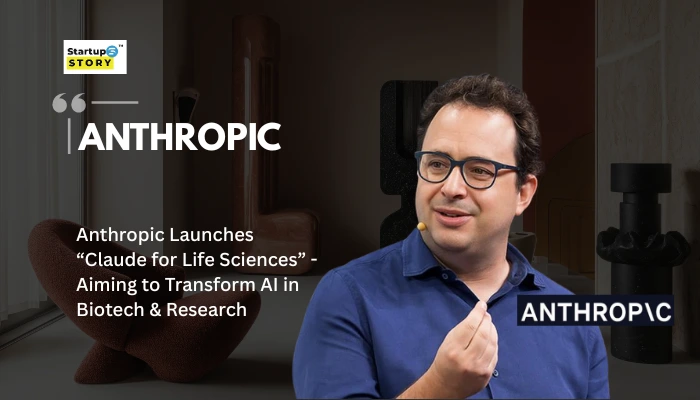
Anthropic Launches “Claude for Life Sciences” – Aiming to Transform AI in Biotech & Research
- ByStartupStory | October 22, 2025
In a major step toward integrating artificial intelligence with life sciences, Anthropic has unveiled Claude for Life Sciences, a specialised version of its flagship model designed to accelerate scientific discovery, streamline research workflows, and support regulated environments in biotechnology and healthcare.
From general-purpose to domain-deep
Until now, Claude has been widely used by scientists and organisations for specific tasks like summarising research papers or generating code. With this launch, Anthropic signals a shift — from assisting parts of the research process to supporting the entire scientific workflow.
Key features include:
- Connectors to major scientific tools and data platforms such as Benchling, BioRender, 10x Genomics, and Synapse, allowing Claude to work natively with experiment records, literature, and complex data.
- Agent Skills, a new capability that enables Claude to perform domain-specific scientific procedures consistently — for example, running a “single-cell RNA-seq QC” analysis automatically.
- Improved performance through its latest “Sonnet 4.5” model, which demonstrates significantly higher accuracy on life-science benchmarks compared to earlier versions.
Why this matters
For startups, researchers, and biotech firms, Claude for Life Sciences represents an important shift in how AI can be applied across research and development:
- Efficiency gains – Tasks such as literature reviews, protocol drafting, and data summarisation can now be completed in minutes instead of days.
- Seamless integration – Claude’s direct compatibility with scientific platforms reduces the friction of adoption in existing lab workflows.
- Vertical AI momentum – The launch reinforces a growing trend where AI models are tailored for specific industries, rather than serving as one-size-fits-all chatbots.
- Focus on compliance – By building traceability and audit features into the product, Anthropic is addressing the regulatory sensitivities that often slow down digital transformation in pharma and biotech.
Challenges ahead
Despite its promise, several challenges remain:
- Proving real-world ROI – Many AI-in-science solutions have struggled to demonstrate measurable results beyond controlled demos.
- Handling domain complexity – Life sciences involves wet-lab experiments, regulatory oversight, and long clinical cycles that AI alone cannot shorten.
- Competition and differentiation – Anthropic will compete with both major AI players and specialised biotech-AI startups already active in this space.
- Data governance and security – Managing sensitive genomic and clinical data will remain a key concern for institutions adopting AI tools.
What to watch
- Early adopters and their measurable outcomes in research efficiency.
- Pricing models and accessibility for startups or small research teams.
- Expansion of integrations across the biotech ecosystem.
- Adoption trends in emerging markets, especially India, where the healthtech and life-sciences sectors are rapidly growing.
Final word
For founders and innovators in the biotech and healthtech ecosystem, Claude for Life Sciences marks a pivotal moment. It shows how generative AI is evolving beyond text and chat interfaces into complex, domain-specialised systems capable of assisting real scientific discovery.
As AI continues to move deeper into regulated, research-driven industries, this launch could redefine how the next generation of biotech startups and research organisations operate — turning AI from a supportive tool into a true scientific collaborator.
Follow Startup Story


Related Posts