
Cabs, Minibuses or Buses: Choosing the Right Vehicle Mix for Your Workforce
- ByStartupStory | October 26, 2026
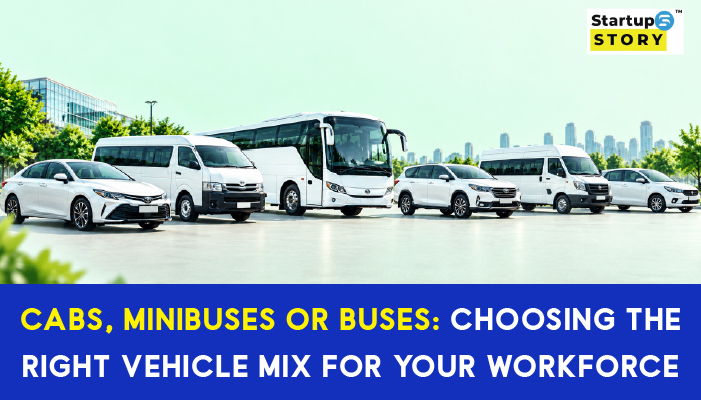
Most transport RFPs ask the questions backwards. They start from the vehicles – how many cabs, how many buses, at what rate per kilometre – and then the mix becomes something of a procurement decision to be negotiated with the vendor later on.
However, it shouldn’t be this way, because the mix is what helps you decide the actual cost for employee transportation. Imagine running a 50 seater, which is being used by only 10 people. That’s so much of your cost down the drain due to poor utilization. So picking the right mix for your transport program becomes crucial to manage costs as well as employee satisfaction.
Deciding the mix requires you to feed in – where your employees live, when their shifts start and end, and what the law requires you to do for the last person in the vehicle. Companies that don’t pick the mix first discover that their costs skyrocket post go-live and their budget won’t support it.
Cost per kilometre is the wrong unit
The number that matters is cost per employee per trip, and it is governed by occupancy rather than by the rate you negotiated. That sounds obvious until you actually run it. Take illustrative per-trip rates and divide by riders actually on board:
| Vehicle | Rate per trip | Riders | Cost per employee |
| 6-seat cab | ₹1,800 | 5 | ₹360 |
| 6-seat cab | ₹1,800 | 3 | ₹600 |
| 26-seat minibus | ₹4,200 | 22 | ₹191 |
| 26-seat minibus | ₹4,200 | 10 | ₹420 |
| 50-seat bus | ₹6,500 | 44 | ₹148 |
| 50-seat bus | ₹6,500 | 18 | ₹361 |
These are illustrative rates and not indicative of any solutions or market average rates.
The half-empty 50-seater costs the same per head as a full office cab. So, the bus was never cheaper than the cab. In reality, high occupancy was cheap, and the bus was just a way of achieving it. However, if you break the occupancy, the entire case for the vehicle disappears while the invoice stays the same size.
This means the first question in any vehicle-mix exercise is not “what should we run” but “how many people share an origin, in the same direction, in the same shift/timing”. Where that number is above roughly twenty, a bus could actually be cheaper. Below eight, it is a more expensive cab with worse commute times.
The morning run is not same as the evening run
This is something most enterprises miss. There’s a reason the two halves of the day need different fleets. Morning traffic is convergent and deadline-bound. Everyone is heading to the same building and has to be there by a fixed time, which makes the load predictable and dense, which is ideal conditions for high-capacity vehicles picking up along a corridor.
The evening is not the mirror image and behaves nothing like it. Logouts stagger across two or three hours, destinations fan out across the city, and the constraint shifts from arrival time to how long someone sits in a vehicle watching colleagues get dropped ahead of them. Consolidation that was free in the morning now costs ride time, and ride time is what employees actually complain about. This is why drop cabs persist in organizations that have otherwise moved to buses: the evening is a dispersion problem, and small vehicles are what solve dispersion.
Procure a single mix for both directions and you will be wrong twice, running buses at 30% in the morning because they were sized for the evening tail, or drop cabs on a corridor that could have carried a minibus.
Safety rules shape the route, not just the policy
In India, Section 43 of the OSHWC Code – women’s consent to night work, plus employer-provided safe transport – are enforced on a national footing. The operational detail, though, still lives in state rules. Karnataka state rules are the ones most transport programmes are actually built around. Under the Shops and Commercial Establishments regime, employers must provide door-to-door transport free of cost with adequate security, run GPS-tracked vehicles, verify driver backgrounds, and route so that no woman employee is picked up first or dropped last. Where that cannot be avoided, a security marshal is expected to be present in the vehicle.
Read that as an economic instruction and it says something specific: the cost of a night route is concentrated in its tail. A guard is a fixed cost per vehicle per trip, indifferent to how many people are aboard. A route ending with one woman thirty kilometres out carries the guard for the whole journey.
That single fact reshapes the mix more than any rate card. It pushes toward routes with short, dense tails – which in practice means a trunk-and-feeder design rather than long point-to-point runs. Large vehicles carry the corridor, small vehicles handle the last few kilometres, and the sequencing of the final three drops is planned deliberately rather than falling out of a distance algorithm.
Running the whole fleet as one system
It is extremely difficult to manage three separate contracts for each vehicle type, but that is how most large enterprises still hold it. And then they end up using a spreadsheet, reconciling them monthly.
End-to-end employee transportation management for large enterprises means the vehicle classes are planned in one pass. Demand is rostered; routing decides which vehicle class serves each cluster; the guard rule is applied as a routing constraint rather than checked afterwards; and billing settles against trips that actually ran. MoveInSync covers that span – office cabs, minibuses and high-capacity buses running fixed-route employee shuttle services in the same platform – with GPS tracking, SOS and safe-reach verification, IVR drop validation and driver compliance monitoring attached to the trip record.
The structural point: occupancy is the variable that decides cost, and you cannot optimise across vehicle classes you procure and measure separately.
Conclusion
The right vehicle mix is not a preference between cabs, minibuses and buses. It is whatever configuration keeps occupancy high in both directions while satisfying certain required conditions.
That configuration is not stable and can keep changing. As headcount moves, shift patterns change, one team can relocate and a corridor that justified a 50-seater no longer does, with the shift. A mix chosen once and locked into a three-year contract is a mix that will be wrong for most of that contract.
So the useful question to ask isn’t which vehicles to run. It’s whether you will be able to tell, next quarter, that the answer has changed, and change your mix based on that.

Follow Startup Story


Related Posts