
The Elephant and the Dragon: Decoding India’s Hotan Route Request
- ByStartupStory | October 10, 2026
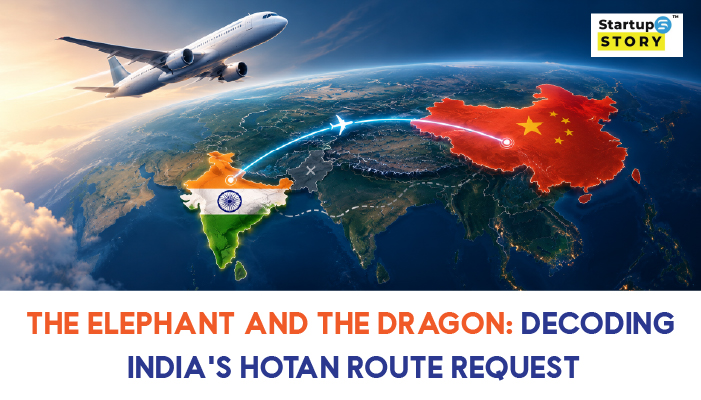
“The Dragon and the Elephant must dance together.” Beijing has used that line for years to describe what India–China ties could become. New Delhi may now be offering its first concrete reply, and the dance floor is the sky over Xinjiang.
On 29 September, Civil Aviation Minister Ram Mohan Naidu confirmed that India and China are discussing the Hotan route, with the Ministry of External Affairs engaging Beijing directly. The idea is simple. Flights from north India would enter Chinese airspace via Leh, cross Xinjiang near Hotan, and continue west to Central Asia, the Caucasus, Russia and northern Europe, bypassing Pakistan altogether.
Why Air India Needs Hotan
Pakistan has kept its airspace shut to Indian-registered aircraft since the Pahalgam terror attack in April 2025, and India responded in kind. Flights from Delhi, Lucknow, Jaipur and Amritsar now swing south over the Arabian Sea towards Oman before turning for Europe or North America. These are longer, costlier journeys, made worse by recurring restrictions over Iran.
Air India has borne the heaviest cost. Former CEO Campbell Wilson put the hit at about ₹4,000 crore, and an internal company estimate pegged the annual impact on profit before tax at roughly $455 million. The Delhi–Washington service was suspended outright.
Air India’s own projections suggest the Hotan corridor could cut fuel burn and flying time, restore capacity trimmed on routes like Delhi–New York and Delhi–Vancouver, and reduce losses by over $1 million a week.
Sovereign Skies, Two Ways
Every nation holds complete and exclusive sovereignty over the airspace above its territory. What it does with that sovereignty says a great deal about it.
Pakistan has turned its skies into a blockade, giving up the overflight fees Indian carriers once paid and hurting its own exchequer to make a point. China, if it agrees, would treat its sky as a service: opened on its own terms, priced, and governed by its own rules. Sovereignty is not diminished by granting access. It is exercised.
What’s in It for Beijing
Plenty. Every Indian flight over Hotan would pay route navigation charges, flight after flight, year after year. That is revenue that once flowed to Islamabad. As the old saying goes, when two neighbours quarrel, a third often profits.
Beyond the money, China would earn diplomatic credit for helping a neighbour at little cost to itself. The airspace is militarily sensitive and ringed by peaks above 20,000 feet, so any approval would likely be limited to specific aircraft. That is exactly why a “yes” would carry weight as a signal of trust.
A BRICS Handshake, Not an Infrastructure Bargain
This is not a connectivity megaproject. There are no loans, no corridors, no construction on Indian soil and no long-term dependencies. It is a plain, reciprocal commercial arrangement between two founding BRICS members: India’s airlines pay standard fees, and China opens a corridor it fully controls.
That is the kind of practical, member-to-member cooperation BRICS was meant to make routine. Partners solve each other’s problems without either giving up an inch of strategic autonomy.
The Road Ahead
No timeline has been announced, and government clearance is still pending, even though reports in March suggested the route was technically feasible for certain aircraft. But the direction is clear. If the Elephant has asked and the Dragon says yes, their first real dance may happen at 35,000 feet, while Pakistan watches from the ground.
Article researched and written by Mayank Sati
Follow Startup Story


Related Posts