Temple acquires London-based longevity medicine practice Longevous
- ByStartupStory | September 1, 2026
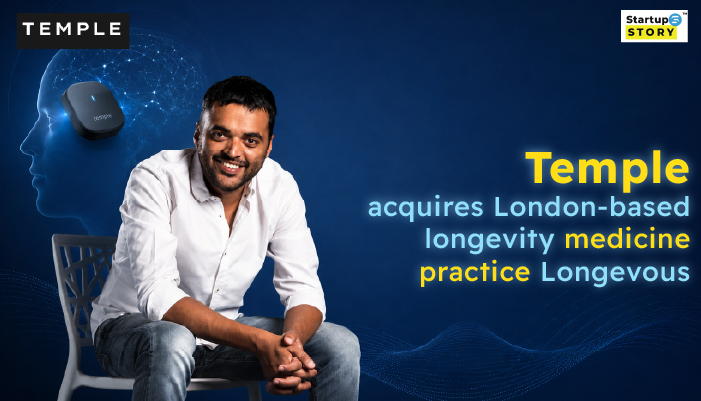
Health-tech startup Temple has acquired London-based longevity medicine practice Longevous for an undisclosed amount. The acquisition will help Temple strengthen its clinical and scientific capabilities as it prepares to launch its wearable health-tracking device.
Founded by Deepinder Goyal, the co-founder and CEO of Eternal, Temple is building technology focused on longevity, preventive health, and continuous monitoring. The company is developing a wearable device designed to be worn near the temple and track physiological signals linked to a person’s health and wellbeing
Longevous is an evidence-based longevity medicine practice that works with clients on improving long-term health outcomes. Its approach focuses on areas such as health monitoring, preventive care, lifestyle changes, and personalised medical guidance.
As part of the acquisition, Longevous founders Dr Robert Mohr and Dr Avi Roy will join Temple full-time. Mohr will become Temple’s chief medical officer, while Roy will take on the role of head of science. Their team will also join the company.
The addition of experienced doctors and scientists is important for Temple because health technology must be supported by credible medical research. A wearable can collect large amounts of data, but that data is useful only when it can be interpreted accurately and connected to meaningful health outcomes.
Temple plans to use Longevous’ clinical experience and scientific expertise to strengthen the validation of its wearable technology. Clinical validation can help determine whether the device measures physiological signals reliably and whether the insights generated from that information are genuinely useful.
The acquisition also gives Temple a direct presence in the UK’s growing longevity and preventive-health market. Longevous will continue operating under the Temple umbrella, and its founders will continue to personally look after existing clients.
For Longevous, joining Temple could provide access to greater technology, engineering resources, and capital. Its doctors and researchers can contribute to the development of digital health products while continuing their work with clients.
The deal reflects a broader shift towards preventive healthcare. Instead of seeking medical help only after symptoms appear, consumers are increasingly interested in tracking sleep, activity, heart health, stress, nutrition, and other indicators that may influence long-term wellbeing.
However, longevity technology also brings challenges. Health data is highly sensitive, and Temple will need strong systems for privacy, security, consent, and responsible data use. The company must also ensure that its health insights are medically sound and do not create unnecessary anxiety or encourage people to make decisions without professional guidance.
The acquisition comes before Temple’s wider product launch, making clinical credibility especially important. Customers may be curious about a new wearable, but they will ultimately judge it based on accuracy, comfort, usefulness, battery life, price, and the quality of the insights it provides.
Temple’s long-term opportunity lies in combining medical expertise with advanced hardware and software. If it can build a device that reliably tracks health signals and turns them into practical guidance, it could create a strong position in the emerging longevity market.
The acquisition of Longevous gives Temple a stronger scientific foundation as it moves towards commercialisation. Its next challenge will be proving that the technology can deliver trustworthy, clinically meaningful, and genuinely helpful information to users.
Follow Startup Story


Related Posts