Experimental Trials for Drone Based Healthcare Network Launched in Arunachal Pradesh
- ByStartupStory | August 15, 2022

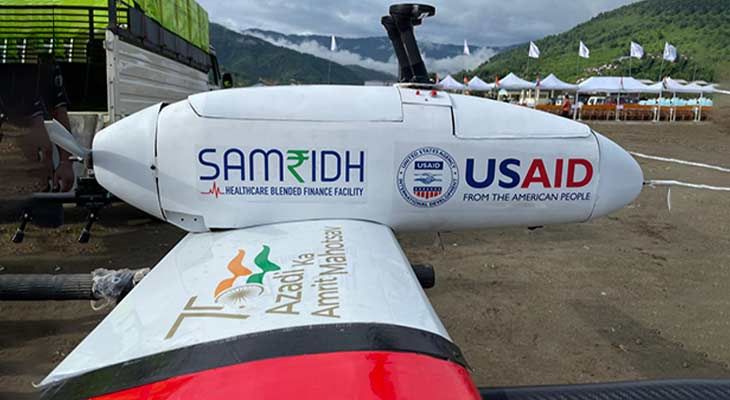
An experimental trial to utilize drones to provide superior healthcare services to tribal and rural communities in Seppa, a town in East Kameng District of Arunachal Pradesh, was launched today (15th August 2022). Redwing Labs, a leading startup, would provide ‘Made in India’ hybrid Vertical Take-off and Landing (VTOL) drones and run end-to-end operations for the project. The pilot project in East Kameng is made possible by the generous financial and technical support from SAMRIDH Healthcare Blended Financing Facility – an initiative supported by United States Agency for International Development (USAID) and implemented by IPE Global. The healthcare drone pilots in Arunachal Pradesh are an outcome of the State’s partnership with the World Economic Forum’s ‘Medicines From the Sky’ (MFTS) initiative.
The drone network is being set-up up on a limited experimental basis to pilot aerial healthcare deliveries in the State. The network would enable diagnostics and emergency treatments in the local health centers.
This pioneering initiative is the outcome of multiple stakeholders collaborating to improve healthcare access to communities in remote areas. This includes The Government of Arunachal Pradesh; World Economic Forum’s ‘Medicines From the Sky’ (MFTS) initiative; Redwing Labs with funding support from SAMRIDH Healthcare Blended Financing Facility – an initiative supported by United States Agency for International Development (USAID) and implemented by IPE Global.
By delivering medical supplies up to eight times faster than road-based logistics, the drone network would serve the population of East Kameng by offering a better quality of care in the interior blocks.
Under the leadership of Hon’ble Prime Minister Shri. Narendra Modi, India started trials and pilots of drone-based deliveries in healthcare in 2021. Multiple states including Telangana, Nagaland, Manipur, Meghalaya, Odisha and Uttarakhand have done pilots and experimental flights. Drones carried multiple health products including vaccines, essential drugs and diagnostic samples. Aerial supply chains have immense potential to solve last-mile healthcare challenges and advance SDG-3 in rural, tribal, and semi-urban locations.
Speaking about the collaboration with Redwing Labs, Mr. Himanshu Sikka, Project Director, SAMRIDH and Chief Strategy and Diversification Officer, IPE Global, said, “SAMRIDH is committed to enable scaling-up of innovative healthcare solutions by improving their access to affordable capital and technical assistance. Our collaboration with Redwing Labs gives us a tremendous opportunity to address supply-chain shortcomings in the healthcare sector to address access and affordability of quality healthcare for the vulnerable populations. We will also be providing impact evaluation assistance that could be useful to develop the drone policy for future drone-based healthcare delivery projects.”
The SAMRIDH initiative was established during the COVID-19 pandemic to support healthcare enterprises and innovators across India implementing market-based health solutions. It provides grants and facilitates debt financing to healthcare initiatives to support scale-up of high impact health solutions that can improve access to quality healthcare for vulnerable communities.
Highlighting the impact of this initiative, Mr. Pravimal Abhishek, IAS, Deputy Commissioner, East Kameng District, said, “East Kameng District has a very hilly terrain which makes it difficult to access interior areas, particularly during monsoons. I am sure the drone based drug delivery will be a game changer in strengthening access to healthcare in such remote areas. Hoping that this pilot would give us the answers and clarity for the future.”
By enabling care at the local level, the drone network aims to reduce out-of-pocket expenditure (OOPE) for patients, increase immunization rates and improve welfare gains. This experimental network would be accompanied by an impact evaluation study to understand the cost-benefit and health impact of using drones in India’s public health system.
Tracing the background of this project, Mr. Vignesh Santhanam, Lead for Aerospace and Drones, at the World Economic Forum, said, “In mid-2021, we undertook a field study in Arunachal Pradesh to learn more about the local health distribution system, disease profile and nature of the terrain. Traversing the Seppa – Bameng belt by road in particular made it evident that drones were an absolute necessity. Through our learnings in Telangana, we are looking to stress test our systems in Arunachal Pradesh under the liberalized drone regime while factoring in economic principles right from the point of initiation.”
Highlighting the technical aspects of this project, Mr. Anshul Sharma, CEO and Co-Founder, Redwing Labs, said, “We are hopeful that this trial will give quantifiable data points on cost & supply chain behavior for drones in public healthcare to kickstart mass adoption. We are pleased and deeply grateful to USAID-Supported SAMRIDH initiative and WEF for their support in this project.”
The ‘MFTS’ is a flagship initiative of the World Economic Forum aimed at seamlessly integrating drones into the intermodal healthcare distribution system particularly in areas that are geographically sensitive and prone to natural hazards that leave rural communities isolated.
This pilot goes beyond just technical feasibility and focuses on multiple aspects, including integration with existing health systems, community involvement, local technology training and employment, and impact on health and economic outcomes.
Rural and semi-urban locations face challenges in obtaining good quality healthcare. As COVID-19 has shown, efficient last-mile supply chains are critical for faster access to vaccines, diagnostics and medical products during health emergencies. India is also subject to frequent adverse weather events. Hilly regions are most challenged.
When health supply chains are disrupted and ineffective, populations are unable to receive the medical care they need. In this regard, drone-based health supply chains have demonstrated success in solving last-mile delivery challenges in healthcare systems worldwide for over seven years.
ABOUT U.S. AGENCY FOR INTERNATIONAL DEVELOPMENT (USAID)
USAID is the U.S. Government’s premier international development agency and a catalytic actor driving development results. USAID works to help lift lives, build communities, and advance democracy. USAID’s work advances U.S. national security and economic prosperity; demonstrates American generosity; and helps countries progress along their development journey. In India, USAID is collaborating with the country’s growing human and financial resources through partnerships that catalyze innovation and entrepreneurship to solve critical local and global development challenges.
ABOUT IPE GLOBAL LIMITED (IPE GLOBAL)
IPE Global is an international development consulting group – the largest in South Asia – providing technical assistance and solutions for equitable development and sustainable growth in developing countries. Headquartered in New Delhi, India with seven international offices in Bangladesh, Ethiopia, Kenya, Myanmar, Nepal, Philippines and United Kingdom, the Group offers a range of integrated, innovative and high-quality consulting services across several sectors and practices. These include Health, Nutrition & WASH, Social Economic Empowerment, Urban & Infrastructure Growth and, Education & Skills Development to name a few. IPE Global has successfully undertaken over 1000 assignments in over 100 countries and, over the years, has transformed the lives of over 600 million people globally.
SAMRIDH Healthcare Blended Finance Facility is supported by the United States Agency for International Development in technical collaboration with Atal Innovation Mission & Women Entrepreneurship Platform, NITI Aayog, Principal Scientific Advisor to the Government of India, the National Health Authority, Indian Institute of Technology Delhi, Rockefeller Foundation, Axis Bank, IndusInd Bank, Caspian Debt and NATHEALTH, and is managed by IPE Global. Through this initiative, SAMRIDH combines commercial capital with public and philanthropic funds to drive greater resources towards market-based health solutions that can improve access to affordable and quality healthcare services for India’s most vulnerable.
SAMRIDH is recognised among ‘India’s top 50 COVID-19 last mile responders’ by the World Economic Forum. The initiative is also one of the five finalists at the P3 Impact Award 2022 led by the Office of Global Partnerships at the U.S. Department of State, Concordia, and the University of Virginia Darden School of Business Institute for Business in Society.
Redwing is an award-winning Indian start-up that designs and operates last-mile aerial healthcare logistics. Its mission is to ensure everyone can access life-saving medical supplies and diagnostics services quickly and affordably. Redwing operates state-of-the-art hybrid Vertical Take-off and Landing (VTOL) aircraft and has executed projects with multiple national and global organizations. Current and past partners include Government of Telangana, Government of Uttarakhand, USAID, Mahindra Logistics, Piramal Swasthya, World Economic Forum, UNAIDS, Bill and Melinda Gates Foundation, WeRobotics, and Centers for Disease Control and Prevention amongst others.

Follow Startup Story


Related Posts