
Razorpay can go public in a few years without needing to raise more money: company founders
- ByStartupStory | November 14, 2022

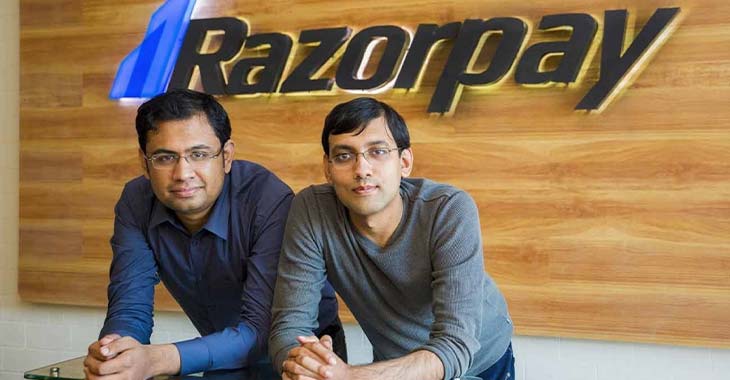
According to founders Harshil Mathur and Shashank Kumar of Razorpay, which won the prestigious Startup of the Year category at the Startup Awards 2022, the company does not need to raise any additional capital because its revenue is growing by 100% annually and it plans to go public within the next two to three years. According to them, the company won’t require additional funding for operations unless a significant strategic need for the company is identified.
The fintech company, valued at $7.5 billion, has already surpassed its GTV (gross transaction value) goal of $90 billion for this year, passing the $100 billion mark even as online businesses are beginning to experience a slowdown. While the tech industry is experiencing a slowdown, the broader Indian ecosystem is not experiencing a decline in consumption, which is driving growth in digital payments from industries like education, travel, and others, according to Mathur, its CEO. Following its acquisition of Ezetap earlier this year, the Bengaluru-based fintech company is also making a strong push into offline payments.
“Our payments operation is almost profitable. If we were to simply go public as a payments company, we would be fairly prepared. But if we go public as just a payments company, we will be doing injustice to the vision we have, Mathur said. “We will be able to connect a lot of aspects related to credit, banking, and now offline, and the platform’s synergies will be much greater. In the coming years, we want to bring them to a place where they are also breaking even before going public.
Additionally, Kumar stated that Razorpay intends to inform investors about its payments, credit, and neo-banking stories as well as its foreign and offline payments. “The markets will also be a lot better able to comprehend that. Fintech and business-to-business (B2B) payments make up a moderately complex ecosystem. It will be difficult to show how these things are connected without evidence, Mathur said, adding that the business is also exploring its possibilities for shifting its headquarters. The parent company of Razorpay is based in the US.
Consumer-focused payment companies like Paytm and Policybazaar were listed on the Indian bourses last year and became public. However, they are currently trading 60–70% below their issue price for a variety of reasons, including investors’ concerns about their capacity to turn a profit. According to the founders, Razorpay, which funded more than $535 million last year, would continue to prioritise expansion over profitability in the years to come.


“As long as we develop our differentiator for ourselves on tech and servicing, it doesn’t matter what happens in the ecosystem,” Mathur remarked in reference to the much-discussed failure of the $4.7 billion Prosus-BillDesk transaction. The BillDesk and Prosus-owned PayU combination would have become the biggest payments processor in the nation if the merger had been completed as expected a year earlier. According to Kumar, Razorpay’s gross merchandise value, or GMV, from new verticals like neo-banking, payroll administration, and others is predicted to increase three- to four-fold, while the company’s payments business will grow at a 100% rate. About 80% of Razorpay’s business is still in its payments division, Mathur said.
“During the epidemic, inbound growth predominated, necessitating less of our time or money in marketing. However, even though it is a non-covid year, we are still increasing at 100% (in terms of revenues). And in the following two to three years, we anticipate maintaining the same growth pace. And internet payments make up over 80% of our company. Our GMV growth would be much higher,” he said, adding that Razorpay will maintain its growth rate because the payment industry’s compound annual growth rate (CAGR) is still very high and many non-internet payment businesses are still transitioning to digital payments.
According to its unaudited financials, Razorpay’s payments division generated an income of over Rs 1,485 crore in FY22 compared to Rs 841 crore the previous year. In FY21, the company reported a standalone net profit of Rs 7 crore, and in FY22, it also generated a profit (undisclosed). Mathur responded that Razorpay has built a sustainable business, which helps them to not be at the whim of the market, when asked if the company was concerned about its high valuation in light of the ongoing correction in startup valuations. Our valuation is neither a cause for joy nor a source of anxiety for us. Our business is not driven by funding, and one benefit of B2B is that it is constructed sustainably. The advantage of B2B is that it is built in a sustainable way, and we are not dependent on just fund infusions, Mathur said. “Funding does not drive our business.


Follow Startup Story


Related Posts